

What Factors Should Be Considered When Choosing Micro Sprinklers for Lawn Maintenance?
2026-03-18
When selecting micro sprinklers for lawn care in the United States, performance consistency and water distribution uniformity are key concerns. Turf quality depends heavily on how evenly water is delivered across different zones, especially in residential landscapes, commercial green spaces, and municipal parks. Our experience shows that poor distribution often leads to dry patches, overwatering, and increased maintenance costs.
Micro sprinklers are widely used in Irrigation systems because they offer low flow rates, controlled spray patterns, and efficient water usage. Compared to traditional spray heads, they are better suited for areas requiring precise coverage such as narrow lawns, landscaped edges, and sloped terrains.
At Micro Mist Irrigation Products Co., Ltd., our factory focuses on delivering stable spray performance under varying pressure conditions. Our product lines are designed to meet common US standards, including PSI compatibility and GPM efficiency. This ensures that our solutions can integrate smoothly into existing Irrigation layouts without system redesign.
Our engineering team prioritizes durability and adaptability, ensuring our products perform well in both residential backyards and large commercial landscapes. Our approach combines field testing and real-world application feedback to improve reliability.
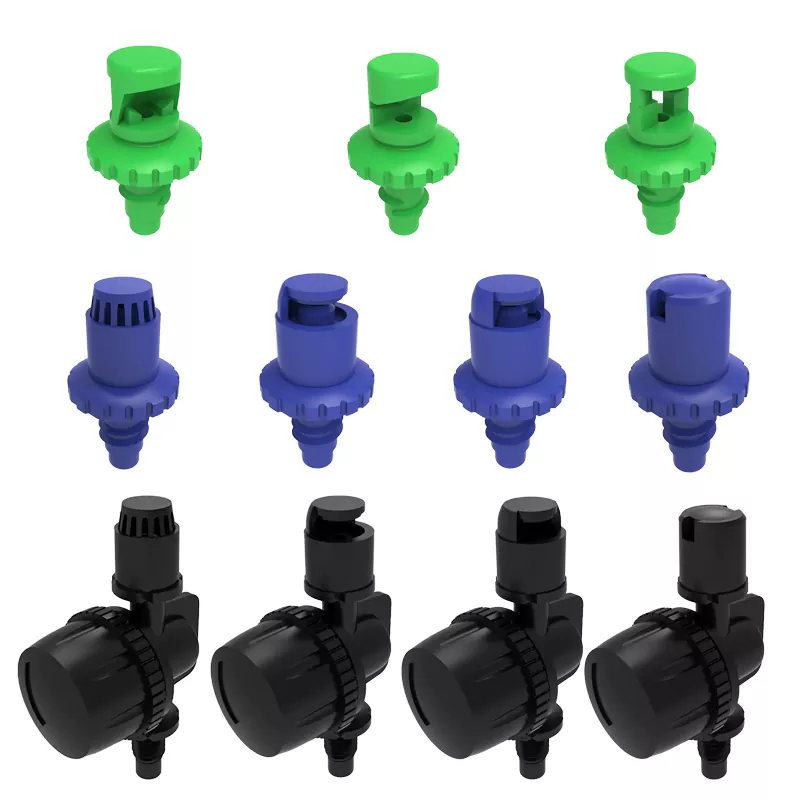
How Do Technical Parameters Affect Micro Sprinkler Efficiency?
Choosing the right micro sprinkler involves understanding key technical specifications. These parameters directly influence coverage, water efficiency, and system compatibility. Our factory recommends evaluating the following factors before making a decision.
| Parameter | Typical Range | Application Impact |
| Flow Rate | 20 to 120 LPH | Determines water output and coverage density |
| Working Pressure | 1.5 to 3.0 bar | Ensures stable spray performance |
| Spray Radius | 1.0 to 5.0 meters | Affects spacing and layout design |
| Spray Pattern | Full circle, half circle, adjustable | Controls targeted watering zones |
| Connection Type | Barbed, threaded | Compatibility with tubing systems |
In many Irrigation setups, improper pressure matching is one of the most common issues. Our products are designed to maintain consistent output even with minor pressure fluctuations, which is critical for maintaining uniform turf growth.
Micro Mist Irrigation Products Co., Ltd. emphasizes precision manufacturing to ensure each nozzle delivers consistent droplet size and distribution. Our quality control process ensures every unit meets strict performance standards.
What Environmental Conditions Should Influence Your Selection?
Environmental factors play a major role in determining which micro sprinkler is most suitable. In regions like California, where water conservation regulations are strict, choosing efficient Irrigation components is not optional but necessary.
Key environmental considerations include wind exposure, soil type, and evaporation rate. In windy areas, low-angle spray micro sprinklers are preferred to minimize drift. Sandy soils require shorter watering cycles, while clay soils benefit from slower application rates to prevent runoff.
Our factory designs micro sprinklers that perform reliably under different environmental conditions. UV-resistant materials are used to ensure long-term outdoor durability, especially in areas with high sun exposure. Our solutions are engineered to reduce clogging risks, even when water quality varies.
Another important aspect is seasonal adaptability. Our products are built to function efficiently across changing weather conditions, ensuring stable lawn performance year-round. This flexibility makes our systems suitable for both residential and commercial Irrigation applications.
How Does Installation and Compatibility Impact System Performance?
Ease of installation and system compatibility are often overlooked but critical factors. A well-designed micro sprinkler should integrate seamlessly with existing tubing, connectors, and control systems.
Our design philosophy focuses on plug-and-play compatibility. Our factory ensures that our products fit standard US tubing sizes and connectors, reducing installation time and labor costs. This is particularly important for contractors managing large-scale landscaping projects.
Below is a comparison of common micro sprinkler types used in lawn maintenance.
| Type | Best Use Case | Advantages |
| Fixed Spray | Small lawns | Simple design, low cost |
| Adjustable Spray | Irregular landscapes | Flexible coverage control |
| Rotating Micro Sprinkler | Medium to large lawns | Even distribution, reduced runoff |
| Misting Type | Delicate turf areas | Fine droplets, minimal soil disturbance |
In advanced Irrigation systems, automation compatibility is also important. Our products can be easily integrated with timers and smart controllers, allowing users to optimize watering schedules based on weather data.
Micro Mist Irrigation Products Co., Ltd. continuously improves product compatibility to meet evolving market needs. Our factory works closely with distributors and contractors to ensure seamless integration across different systems.
Why Should Durability and Maintenance Be a Priority?
Long-term performance depends on material quality and maintenance requirements. Frequent replacements increase operational costs and disrupt lawn care routines. Our factory prioritizes high-grade plastics and anti-clogging designs to extend product lifespan.
Clogging is one of the most common issues in micro sprinkler systems. Our products incorporate filtration-friendly designs and optimized flow channels to reduce blockage risks. This ensures consistent performance even in challenging water conditions.
Routine maintenance should be simple and efficient. Our designs allow easy disassembly and cleaning, minimizing downtime. For professional landscapers, this translates into lower maintenance costs and improved operational efficiency.
In modern Irrigation practices, sustainability is also a growing concern. Durable products reduce waste and support long-term environmental goals. Our commitment to quality ensures that our solutions meet both performance and sustainability expectations.
FAQ
What is the ideal pressure range for micro sprinklers in lawn applications?
The ideal pressure range typically falls between 1.5 and 3.0 bar. Operating within this range ensures consistent spray patterns and prevents misting or uneven distribution. Systems running below this range may produce weak coverage, while higher pressure can cause excessive water drift and inefficiency.
How do I choose the right spray radius for my lawn?
The correct spray radius depends on lawn size and layout. For small residential lawns, a radius of 1 to 2 meters is usually sufficient. Larger or irregular areas may require adjustable or rotating micro sprinklers with a radius of up to 5 meters. Proper spacing is essential to achieve head-to-head coverage and avoid dry spots.
Are micro sprinklers suitable for all types of lawns?
Micro sprinklers are highly versatile and suitable for most lawn types, including residential turf, landscaped gardens, and commercial green spaces. However, their effectiveness depends on proper system design, including pressure regulation, spacing, and environmental considerations. They are especially beneficial in areas requiring precise water control.
Conclusion
Choosing the right micro sprinklers involves evaluating technical specifications, environmental conditions, system compatibility, and long-term durability. A well-selected product not only improves lawn quality but also enhances overall Irrigation efficiency and reduces operational costs.
Our factory combines engineering expertise with real-world application insights to deliver reliable solutions for modern landscaping needs. If you are looking to upgrade your system or need customized recommendations, contact our team today to explore how our products can support your next project.