

Custom Aluminum Profile Protective Film Solutions for Superior Surface Protection
2026-10-13
What separates a flawless aluminum profile from a rejected one? Often, it's the film protecting it. Standard films rarely hold up against sharp edges, tight bends, or the rigors of shipping and installation. That's why custom protection matters. Shire specializes in custom aluminum profile protective film solutions that deliver superior surface protection—keeping every profile pristine from production to project completion.
Why Generic Film Fails on Complex Profiles
A film's ability to handle a complex profile comes down to how it distributes tension. Generic films are typically cast from a single, uniform layer with limited elongation. When forced around a tight bumper corner or into a deep recess, the material stretches unevenly. The outer edge thins out, the adhesive layer gets pulled away from the surface, and the film's memory tries to snap it back to its original flat shape. Within days, you get lifting at the edges, distortion lines through the middle of the curve, and a visible stress mark that no amount of heat can relax.
Generic films also lack the tailored adhesive chemistry needed for low-energy or sharply angled surfaces. Most are built for quick, flat installations, using an aggressive initial tack that works fine on a hood but becomes a liability on a side mirror or a bumper sensor housing. The adhesive grabs too quickly, preventing repositioning, or it doesn't wet out properly on the curved area, leaving micro-channels where moisture and dirt creep in. The result is the same: the film fails exactly where the shape gets interesting.
Precision Slitting to Match Your Die Lines
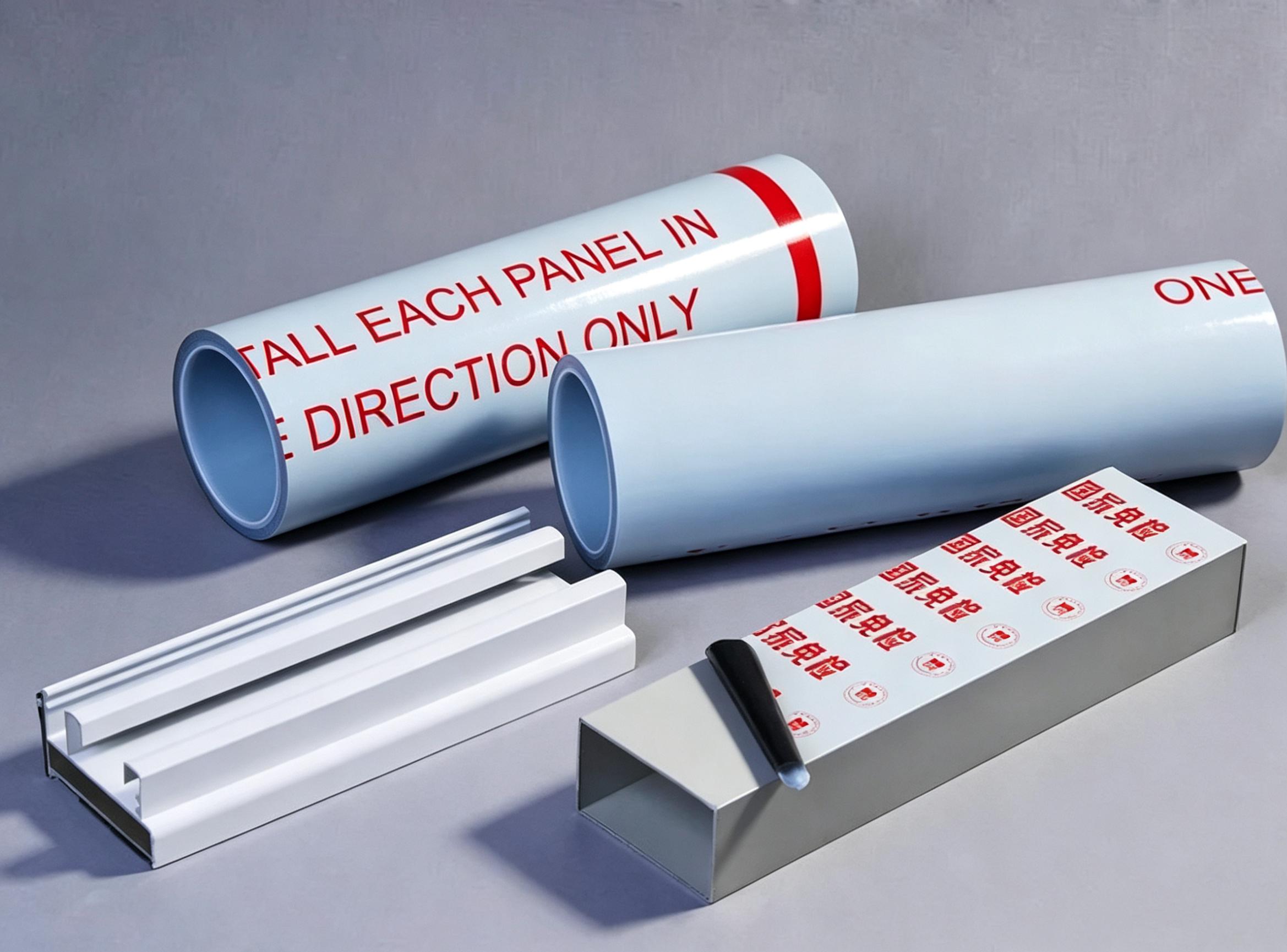
Slitting that matches your die lines means the blade follows what's actually printed or scored on the sheet, not just a theoretical measurement from the CAD file. Our operators check the first few feet against the customer-supplied die line overlay and fine-tune the lateral position in thousandths of an inch. This catches sheet-to-sheet variation before it becomes a pile of off-spec stock.
For jobs where the die line runs at an angle or the substrate tends to drift, we use a camera-based line tracker that locks onto the existing score or printed rule. The slitter's blade carriage shifts automatically as the web moves, so the cut stays on the die line even when the material isn't perfectly straight. That keeps downstream folding and gluing lines from jamming due to uneven trim.
Adhesive Chemistry Tuned for Low-Energy Surfaces
Bonding to polyolefins and fluoropolymers has long frustrated engineers, since these substrates present surface energies below roughly 30 mN/m and offer no reactive handles for typical adhesives. Rather than relying on mechanical interlocking alone, modern formulations adjust the adhesive's own surface tension and polarity to close the wetting gap. For example, incorporating short-chain fluorinated or silicone-based wetting agents drops the liquid adhesive's surface energy enough to spread across low-energy plastics, while retaining cohesive strength after cure.
A second lever lies in tailoring the cure chemistry to generate interfacial covalent bonds. Plasma or corona pretreatment creates transient hydroxyl and carboxyl groups on polyethylene, which then react with isocyanate or silane functionalities built into the adhesive backbone. In one industrial approach, a moisture-curing polyurethane prepolymer carries pendant trimethoxysilane groups; these hydrolyze and condense with surface oxides to form siloxane linkages that anchor the bondline even under peel or shear stress.
Balancing these modifications demands attention to viscoelastic properties as well. Low-energy surfaces often amplify stress concentration at the interface, so adhesives tuned with a slight reduction in crosslink density or the addition of flexible oligomer segments can dissipate energy more effectively. Recent work with acrylic pressure-sensitive adhesives shows that a combination of low-Tg monomers and a small amount of fluorinated comonomer improves peel adhesion on untreated polypropylene by nearly threefold compared to conventional formulations, without sacrificing tack or shear resistance.
UV-Stable Films That Won't Shatter on Removal
Most films turn brittle after a few seasons of direct sun, cracking into stubborn flakes when you try to peel them off. UV-stable films are formulated differently. They hold their tensile strength even after prolonged exposure, so removal stays clean—one smooth pull lifts the entire sheet without leaving behind a mosaic of sharp shards.
The secret lies in the additives blended into the polymer base. Instead of letting UV radiation break down the molecular chains, these compounds absorb and dissipate the energy harmlessly. That means the film keeps its flexibility years down the line, and you won't need a razor blade or solvent to scrape off brittle remnants.
For anyone who has spent an afternoon picking tiny pieces of degraded film off a window, the difference is immediately obvious. These films are designed for real-world use on cars, glass doors, and display screens where long-term clarity matters as much as easy maintenance. Installation is simple, but removal is where the quality truly shows.
Application Speeds That Keep Fabrication Moving
Fabrication shops don't have time to watch a progress bar. When a customer changes a dimension or asks for a different material, the software needs to catch up before the next cut is scheduled. Slow response times force programmers to wait between toolpath calculations, and that waiting turns into idle machines. Keeping the application snappy means a revision stops being a bottleneck and starts being just another step in the workflow.
The places where speed matters most are often the least visible: recalculating a nest after a sheet size changes, updating inventory counts after a job posts, or pulling up a part history while someone is on the phone. If these actions lag, people stop trusting the system and start keeping manual workarounds. Fast interactions make the software feel less like a hurdle and more like an extension of the shop floor.
What really keeps fabrication moving is predictable performance under real workloads. A quote can be turned around in minutes instead of hours. A cutting program can be adjusted while the operator waits, not after the shift ends. Over time, those saved minutes show up as more jobs through the same machines and fewer late nights chasing schedule gaps.
Zero Residue Even After Heat Cycling
Most tapes leave behind a gummy mess once they've been through a few thermal cycles. This one doesn't. Even after repeated exposure to high heat followed by rapid cooling, the adhesive lifts cleanly from stainless steel, glass, and powder-coated surfaces. There's no scraping, no solvent wipe-down, no sticky halo outlining where the tape used to be.
Part of that comes down to how the polymer chains crosslink during the first heat exposure. Instead of breaking down into softer fractions that cling to the substrate, the adhesive holds its cohesive strength and releases at the interface. The result is a clean break every time, whether you're pulling it off a hot engine cover or peeling it away after an oven cure.
For production lines that run continuous thermal cycling, that kind of predictability matters. Operators spend less time cleaning parts between stages, and there's less chance of contamination carrying over into a coating or bonding step. The tape simply comes off the way it should—no residue, no extra work.
FAQ
Consider the profile geometry and handling conditions. Flat, simple extrusions often do fine with 50-70 micron film, but profiles with deep grooves, sharp corners, or long-distance shipping need 80-120 micron film to avoid punctures and edge lift. If the aluminum will be bent or formed after filming, a thicker, more elastic film prevents splitting.
Not always. Indoor storage allows for a general-purpose film, but outdoor exposure demands UV-stable adhesives and a weather-resistant backing. Without UV inhibitors, the film can break down, become brittle, and leave stubborn residue after a few weeks. For projects that sit on job sites, request a film rated for 3-6 months of outdoor durability.
Residue usually comes from a mismatch between adhesive and surface finish, or from leaving the film on too long. Heat, high humidity, and direct sunlight accelerate adhesive transfer. On powder-coated or anodized profiles, a clean-removal acrylic adhesive with a low peel strength is safer. Always test on the actual finish and specify the expected dwell time to the film supplier.
You can customize thickness, adhesion level, color, and even add printed logos or installation guides. Some manufacturers offer perforated or pre-cut pieces for repetitive profiles. For high-volume lines, custom film with a tailored unwind tension and release liner can reduce application downtime significantly.
Edge lift is common on sharp radii and narrow channels. Using a film with a conformable backing and higher initial tack helps, but die-cutting or notching the film to match the profile shape works even better. In some cases, applying a thin edge-sealing tape after the main film prevents peel-back during transit.
Yes, but it requires careful adhesive selection. A medium-tack rubber-based adhesive often works on both, but anodized surfaces can be more sensitive to residue if the film is left on past its rated time. A better approach is to use a multi-surface acrylic adhesive that has been tested for both finishes, and run a small batch trial before committing to a full order.
Ask for peel adhesion, tensile strength, elongation, and UV aging reports. Better yet, request a sample roll and test on your actual profiles under real conditions: apply, leave for the expected duration, expose some to sunlight, then remove and check for residue, ghosting, or surface changes. A reputable supplier will also provide technical support for application and removal speed adjustments.
Absolutely. Many custom films are designed for automatic applicators with consistent unwind tension and low static buildup. The key is specifying the right roll width, core size, and splice-free lengths to match your equipment. For lines running at 50+ meters per minute, a film with low elongation and stable release properties avoids wrinkles and downtime.
Conclusion
Standard protective film rarely survives the realities of extruded aluminum. It bridges across screw ports and deep channels, snags during handling, and leaves adhesive behind exactly where the profile is most visible. Custom solutions start with slitting tolerances that mirror your actual die drawing, not a generic width pulled from inventory. The adhesive is selected for the surface energy of your finish—anodized, mill, or powder coated—so it wets evenly without needing aggressive pressure. This matters most on complex shapes where a few millimeters of exposed edge can turn into a scratch magnet before the part reaches the fabricator.
The right film also has to survive time and temperature. UV-stable formulations won't embrittle after weeks on outdoor racks, which means the film strips away in one piece instead of shattering into chips that slow down installers. Heat from powder coating ovens or summer shipping containers shouldn't cook the adhesive into a gummy residue. Specifying a film that releases cleanly after heat cycling keeps rework off the line. And because application speed directly affects throughput, a film that lays down flat at production pace—without wrinkles or lifting at the cut ends—keeps fabrication moving instead of forcing operators to slow down and re-press edges.
Contact Us
Contact Person: Jack Xu
Email: [email protected]
Tel/WhatsApp: 8615257328825
Website: https://www.temporaryprotectivefilm.com/