

China Refined Montana Wax Manufacturer for Reliable Industrial Supply
2026-09-16
When industrial production depends on refined Montana wax, good-enough suppliers are a risk you can't take. XUSHI, a China-based refined Montana wax manufacturer built for reliable industrial supply, offers a different level of dependability. This guide explores what sets their wax apart—and why it matters for your bottom line.
Why Chinese Refined Montana Wax Earns Its Place on Industrial Spec Sheets
Montana wax refined in China has quietly moved from a niche alternative to a staple on industrial specification sheets, and the reasons have little to do with cost alone. The refining process strips out the inconsistencies found in raw lignite-derived wax, yielding a product with a narrow melting range, low acid value, and exceptional hardness that formulators can rely on batch after batch. When a production line depends on predictable viscosity and slip resistance, that repeatability becomes more valuable than a lower upfront price.
What sets Chinese refined Montana wax apart is the way it bridges the gap between performance and practicality. The country's refiners have invested heavily in solvent dewaxing and oxidation control, resulting in wax variants that mimic the polar, high-melting characteristics of traditional European grades while offering tighter lot-to-lot consistency. For engineers writing material specs, this means fewer reformulations and less time spent compensating for wax drift in polishes, coatings, or rubber processing aids.
The wax earns its place on spec sheets because it behaves like a true functional additive, not just a filler. Its compatibility with paraffins and polyethylenes allows for customized blends that retain clarity in solvent-based systems or provide durable, high-gloss films in carnauba replacements. When a spec calls for scratch resistance, water repellency, or controlled coefficient of friction, Chinese refined Montana wax delivers the data to back it up, making it an easy inclusion for any industrial chemist focused on long-term performance.
The Production Steps That Turn Raw Montana Wax into a Reliable Input
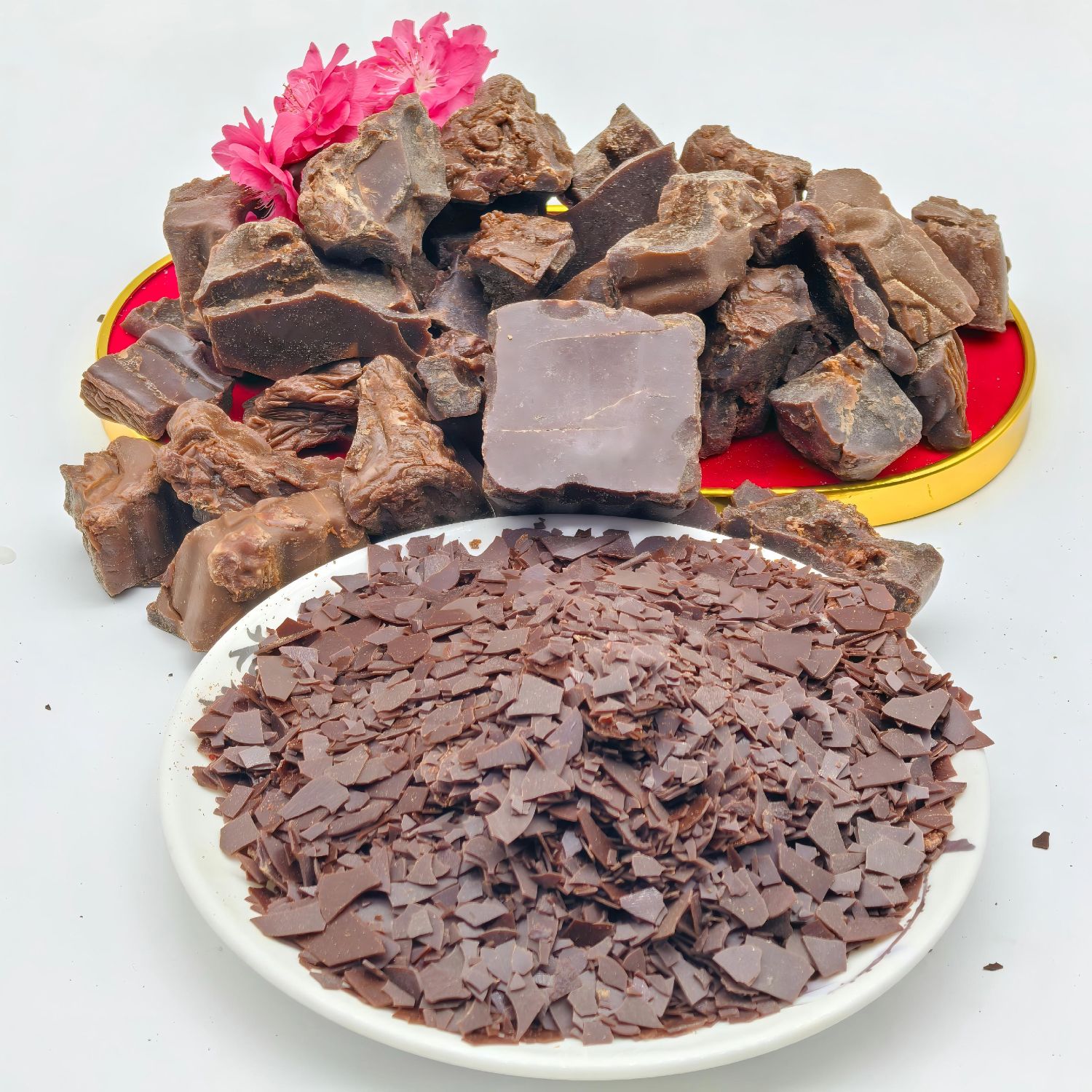
Raw Montana wax begins as a dull, brownish lignite that has to be milled and dried until moisture falls below a set threshold. The crushed material is loaded into an extraction train where a heated solvent blend pulls the crude wax away from the spent coal. The heavy extract leaving the extractor still carries resins and asphaltic compounds, so it goes through a de-resining pass with a cooler secondary solvent that drops out the unwanted fractions.
The de-resined crude then moves into controlled oxidation. Air is introduced under heat and pressure, which raises the melting point, lightens the dark color, and develops the acid and ester values that later dictate how well the wax blends with emulsions and polymer systems. After oxidation, the wax is washed with hot water and passed through plate filters to remove catalyst residues and fines.
The final stage is finishing. The oxidized wax is distilled under vacuum or put through a molecular separator to isolate narrow fractions with consistent hardness, congeal point, and viscosity. Each batch is then blended against a reference standard. Only lots that fall within the tight bands for acid number, color, and drop point are released as a reliable input for downstream compounding.
No More Guessing: How Consistent Refining Cuts Down Line Stoppages
Line stoppages rarely come with a clear warning. Most of the time, operators are left chasing a symptom—noise, vibration, a slight change in cycle time—without a reliable way to separate normal variation from an actual drift. Consistent refining replaces that guesswork by making small, measured adjustments part of the daily routine. When every shift works from the same baseline parameters and documents the exact changes made, the cause of a slowdown becomes visible before it forces a stop.
Repetition is what separates a lucky fix from a dependable one. A single tweak to speed, feed rate, or clamping pressure might solve today’s issue, but without a repeatable method it also erases what was learned. Consistent refining builds a running record of what works and what doesn’t under real conditions. Over time, that record turns into a set of narrow operating windows—each one tied to a specific material, tool, or shift condition. Instead of reacting to an alarm, the line team can adjust early, often during a planned pause, and keep the line moving.
That shift in timing is what actually reduces stoppages. When adjustments are small, frequent, and based on the last verified state, they rarely overshoot. The line no longer waits for a failure to prove the process is off. Refining becomes part of the process itself, not an emergency response. In practice, plants that adopt this rhythm tend to see fewer hard stops and shorter recovery times—because the question is no longer “what changed?” but “what is the next small correction?”
A Buyer's Checklist for Sourcing Refined Montana Wax from China
Before you commit to a Chinese supplier for refined Montana wax, pin down the actual refinery location and the feedstock origin. China's Montana wax producers often blend imported crude lignite wax with domestic material, and that blend ratio directly affects hardness, acid number, and color. Ask for a mill certificate that names the mine or raw wax lot, not just the processing plant. A supplier who can't trace the feedstock is usually blending on price rather than specification.
On the sample bench, test beyond the standard drop melting point. Run an acid number, saponification value, and viscosity at multiple temperatures, because refined Montana wax used in polishes and coatings fails quietly when the ester fraction drifts. Also check ash content and benzene insolubles—low numbers here separate properly de-resined wax from lightly filtered crude. Have the supplier pull retention samples from three separate production days and compare them against your own lab results before signing off on the first container.
Finally, lock down packaging and export details early. Refined Montana wax shipped in flake form can cake badly in humid southern Chinese ports, so specify moisture-resistant kraft bags with an inner polyethylene liner and ask for a loading photo from the factory. On payment terms, don't accept a low price without an agreed specification sheet attached to the proforma invoice. The real cost shows up later as rejected batches, demurrage, or re-melting fees if the wax arrives softer or darker than your pilot run.
Where Custom Blends Meet Large-Scale Capacity Without Compromise
Many suppliers can handle a one-off custom blend request, and plenty can run high-volume production. The hard part is finding a partner that does both without letting the smaller details slip. That gap is exactly where this operation lives. From the first sample batch to a full production run, the recipe, particle size, and sensory profile stay locked in—not just close enough, but identical.
What makes that possible is a deliberate mix of flexible batching systems and strict process controls. Small runs get the same attention as bulk orders because the line doesn't treat them as interruptions. Changeover times are short, but not reckless. Every lot is checked against the original spec before it leaves, so scaling up doesn't mean quietly shifting the formula to make it easier to run.
The result is a simpler conversation: tell us what you need, get the same blend back whether you order 50 kilos or five tonnes. No bait-and-switch on quality, no long lectures about minimum order quantities. Just a process built to respect the custom part and the large-scale part equally.
The Difference Between Refined and Actually Usable in Industrial Wax
A refinery can strip a wax down to its barest chemical profile and still hand you something that fails on the line. Refined means impurities are gone; it says nothing about how the material behaves under heat, pressure, or repeated stress. Actually usable means the wax holds its viscosity when the machine runs hot, releases cleanly from a mold without leaving residue, and doesn't crack or bloom after cooling. The gap between the two is where most production problems hide.
Refinement is a purity metric, not a performance one. A highly refined paraffin might have almost no oil content, yet still be too brittle for a flexible coating or too soft for a structural binder. Usability depends on chain length distribution, crystalline structure, and how the wax interacts with additives. You can have two waxes with identical melting points and oil percentages, and one will gum up a spray nozzle while the other flows perfectly. That difference won't show up on a certificate of analysis.
Smart buyers test for behavior, not just numbers. They run a small batch, check the surface finish, measure shrinkage, and see how the wax responds to a second heat cycle. A wax that performs well in the lab but fails on the floor is refined; a wax that survives your actual process without constant adjustment is usable. That distinction is more valuable than any purity rating.
FAQ
It offers an uncommon balance of hardness, high melting point, and compatibility with natural and synthetic resins, which reduces formulation adjustments across different production lines.
Reputable producers test acid value, saponification value, and drop point on every lot, and often use closed-loop refining systems that strip out resins and dark impurities before final micronization.
Automotive polishes, industrial coatings, rubber release agents, paper sizing, and specialty printing inks are the main buyers, though it also appears in niche cosmetic and adhesive formulations.
Yes, many suppliers adjust hardness, color, and particle size distribution. Some offer blends with carnauba or polyethylene wax to match exact slip, gloss, or anti-blocking requirements.
Check whether the manufacturer controls the raw lignite source, operates in-house refining rather than trading, provides small trial samples, and documents heavy metal and PAH test results.
It often delivers better solvent retention and paste structure in polishes, while giving coatings a deep, non-plastic gloss. Synthetics may win on color or price, but Montana wax tends to outperform in durability and feel.
Depending on the grade and whether blending or micronization is needed, production usually takes two to four weeks. Shipping to major ports in Europe or North America commonly adds another three to six weeks.
Conclusion
A dependable industrial wax supply chain starts with more than a certificate of analysis. When sourcing refined Montana wax from China, the gap between a clean spec sheet and a material that actually performs on your line comes down to how consistently the refining process removes resins, asphaltenes, and other unwanted fractions. Leading manufacturers run deoiling, oxidation, and bleaching stages under tight batch controls, which is why their output earns a place on formal procurement documents rather than remaining a sample-room curiosity. The result is predictable melting behavior, color stability, and compatibility with additives, all of which matter far more than a generic 'refined' label.
For buyers, the checklist should go beyond price per kilogram. Ask about the source of the crude montan wax, the solvent recovery system, and whether the refiner can hold viscosity and acid number within narrow limits across multiple containers. Consistent refining directly reduces line stoppages caused by filter plugging or mold sticking. At the same time, Chinese producers with custom blending capability and large-scale reactors can adjust hardness, emulsifiability, or gloss for your specific application, whether it is for polishes, coatings, or rubber processing, without sacrificing lot-to-lot uniformity. That is the difference between wax that is merely refined and wax that is actually usable in a demanding industrial environment.
Contact Us
Contact Person: Alan Zhu
Email: [email protected]
Tel/WhatsApp: 8613931838766
Website: https://www.cnxushibeeswax.com