

China PVC Board Hot Stamping Foil Exporter Delivers Premium Metallic Finishes for Durable Surfaces
2026-09-17
When it comes to giving PVC boards a premium, long-lasting metallic touch, few do it better than China’s specialized hot stamping foil exporters. Yet among them, GUMPTION has quietly earned a reputation for finishes that don’t just shine on day one—they hold up under real-world wear. So what separates a truly durable metallic surface from one that fades or flakes? In this post, we pull back the curtain on the materials, techniques, and exporter know-how that make all the difference.
Metallic depth that survives daily wear
The finish isn't just a thin coat that flakes off after a few weeks. The metallic particles are bound into the resin at a microscopic level, so the depth stays intact even when keys, coins, and rough pockets rub against it every day. That means the surface keeps its multi-layered shimmer instead of turning dull or patchy.
What makes the depth different is the way the metal flakes are oriented randomly rather than laid flat. Light catches them from different angles, so the surface shifts subtly as it moves. And because that texture is locked beneath a hardened clear layer, it doesn't smooth out or fade with constant handling.
Daily wear usually leaves fine scratches that flatten the metallic look. Here, the top coat is designed to flex slightly instead of cracking, and the metal depth remains suspended below the surface. You'll see the same rich, dimensional finish after months of use as you did on day one.
Why PVC boards need a different foil chemistry
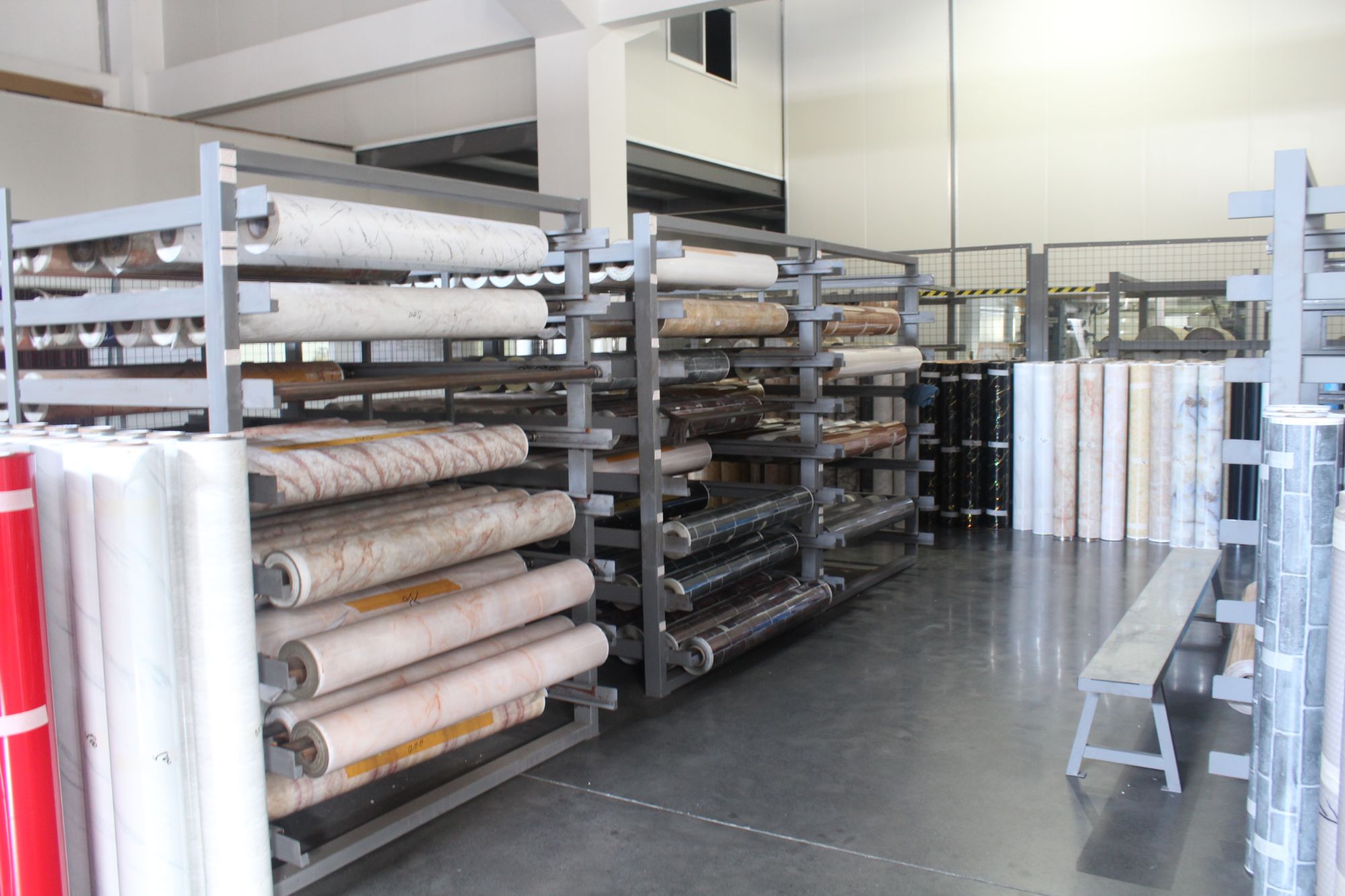
Standard foils rely on a balance of wax release and heat-activated adhesive tuned for porous, heat-stable surfaces like paper or ABS. PVC board behaves differently. The surface is dense and non-porous, so there is almost no mechanical key for the adhesive to grip. At the same time, the vinyl formulation contains plasticizers and processing aids that slowly migrate to the surface. Those migrants act like a contamination layer, weakening the bond and causing edge lift weeks after lamination. A foil intended for PVC has to use a more aggressive, plasticizer-resistant adhesive system—often a modified acrylic or polyurethane—that can bond through that boundary layer instead of relying on surface roughness.
Temperature is the second issue. PVC begins to soften and can release hydrogen chloride well below the activation range of many general-purpose foils. If the foil chemistry is not adjusted, the heat needed to transfer the foil will deform the board or cause micro-blisters where gas escapes. PVC-specific foils are formulated with lower-melting resin binders and faster crosslinking so the dwell time is short enough to avoid thermal damage. The release coating and carrier film must also tolerate chlorine outgassing without hazing or yellowing the metallic layer.
On top of that, many PVC boards are foamed, which means the core is full of gas cells. That makes the surface slightly compressible and uneven in density. A foil designed for rigid plastic sheet can bridge tiny surface voids but not the larger cell openings near a cut edge. So the chemistry has to balance flow and hold-out: enough melt to fill micro-irregularities without bleeding into the foam or telegraphing the cell pattern through the finish. This is why off-the-shelf foils often look fine initially but fail later, while PVC-grade foils are built around that specific surface behaviour.
From flat sheets to luxury furniture finishes
Most people see a flat sheet of MDF or particleboard and think of warehouse shelving. But the journey from that raw panel to a surface that belongs on a five-figure sofa is a study in material manipulation. It starts with the core, which is often densified and balanced to resist warping, then moves through a sequence of sanding grits so fine they feel closer to polishing than abrasion. By the time the base is ready, it has almost nothing in common with the board that came off the press.
The real transformation happens at the coating stage. Lacquers are built up in thin, controlled layers, each one cured and inspected before the next is applied. Some workshops still use hand-rubbed oil finishes that sink into the fibers and harden over days, while others rely on UV-cured polyurethane for a glass-smooth depth. The goal is never just a shiny surface. It is a finish that invites touch, that changes under different light, and that hides the industrial origin completely.
What emerges is no longer a sheet. It is a furniture skin with a quiet, expensive presence. The edges are sealed, the corners softened, and the final sheen calibrated to the piece it will cover. Whether it ends up on a console, a headboard, or a dining table, the material has been taught to behave like something far more precious than its humble beginning.
Shipping foil rolls without creasing or tarnishing
Shipping foil rolls without creasing or tarnishing starts with how the roll is supported inside the carton. A rigid core that extends slightly past the foil edges prevents the outer layers from touching the box walls, and that core should be suspended with foam end caps or die-cut inserts—never resting directly on the floor of the container. When a roll sits on its own weight for even a short drive, road vibration works the bottom layers into permanent fold lines that no amount of unspooling can remove.
Moisture is the quiet culprit behind most tarnishing complaints. Before sealing the outer carton, wrap each roll in a vapor-barrier film and tuck a small desiccant pouch into the tube if the route passes through humid regions. Skip the recycled corrugated liners that still carry residual acids from old printing inks—those fumes can dull aluminum and tin surfaces over a multi-day haul.
Upright orientation arrows on every package do more than satisfy a warehouse checklist. They stop the all-too-common mistake of stacking heavy boxes on top of lightweight foil rolls, which leaves microscopic compression marks that only show up after the customer loads the roll onto a machine. Ask the carrier to keep the shipment isolated from high-stack pressure, and if the roll must lie flat, use a full-length cradle rather than two point supports at the ends.
Matching Pantone shades across production runs
Achieving the same Pantone shade across multiple production runs rarely works out as simply as reusing the same ink formula or dye recipe. Small shifts in substrate texture, ambient humidity, mixing time, or even the age of a pigment batch can nudge the final color away from the approved standard. In practice, printers and manufacturers rely on a combination of controlled lab drawdowns and inline spectrophotometers to catch these drift patterns early. Comparing measured values against the original Pantone reference—usually by tracking Delta E and spectral curves rather than eyeballing a swatch—gives a more reliable pass/fail signal before a whole run goes off target.
What often separates consistent suppliers from those with color complaints is not better equipment but a tighter feedback loop. Teams that keep a physical master sample sealed away from light and heat, then require every new batch to be checked against that same master under identical lighting, tend to see fewer rejected lots. Some also bake a small tolerance range into their workflow, for example accepting a Delta E of 1.2 or less for packaging but holding textiles to under 0.8. The trick is documenting every adjustment—whether tweaking viscosity, adding a touch of white or black, or changing dryer temperature—so that the next run doesn’t start from scratch. Over time, those notes turn color matching from guesswork into a repeatable habit.
Surface prep secrets for lasting foil adhesion
Foil adhesion fails quietly. You sand, you wipe, you think the surface is ready, and then three weeks later the edges start lifting like a bad laminate. The secret most people skip is degreasing after sanding, not before. Sanding drives oils and silicones deeper into the pores, and a quick alcohol wipe just smears them around. Use a two-step wipe: first a dedicated wax and grease remover, then a clean microfiber with isopropyl alcohol at 70% or higher. Let it flash off fully before you even open the foil.
Temperature matters more than pressure. Foil adhesive needs the substrate to be warm enough to wet out properly, but too hot and the solvent flashes before the adhesive can bite. Aim for 18-24°C on the surface, not the room. If you're working on metal or glass, pre-warm it gently with a heat gun on low or let it sit in the sun for ten minutes. Then burnish with a hard felt squeegee, not a soft plastic one. Soft squeegees skip over microscopic texture; a firm felt pad forces the adhesive into every pore.
The final overlooked step is post-application curing. Do not test adhesion by peeling right away. Foil adhesives are pressure-sensitive but they crosslink over 24-48 hours. Leave the piece somewhere dry and dust-free, and resist the urge to trim edges with a blade until the adhesive has fully set. If you must handle it, wear nitrile gloves—skin oils on fresh foil edges are the number one cause of late failure that gets blamed on cheap foil.
FAQ
It works well on rigid PVC boards, WPC foam boards, and similar plastic composite panels. The foil adheres cleanly without peeling or cracking, even when the board is cut, routed, or edge-banded.
The foil includes a protective top coat that resists scratching, fading, and moisture. Many buyers use it for interior doors, wall panels, and furniture edges that get daily handling.
Yes, the exporter offers custom color matching and can replicate wood grain, brushed metal, or abstract geometric patterns. Minimum order quantities depend on the width and number of colors.
They focus on consistent release performance and low waste during lamination. Their technical team often helps clients adjust temperature and speed settings to avoid common defects like silvering or incomplete transfer.
Absolutely. The foil creates a sealed, non-porous surface that resists humidity and cleaning chemicals. It's a practical alternative to painted or laminated finishes in wet areas.
Standard widths range from 640mm to 1280mm, with custom slitting available. Roll lengths typically vary between 500 and 2000 meters, depending on the foil thickness and pattern repeat.
Keep rolls in a cool, dry place away from direct sunlight and high humidity. Ideally, let the material acclimate to the workshop temperature for 24 hours before stamping to prevent condensation issues.
Yes, they offer remote guidance on machine settings, silicone roller hardness, and pressure adjustment. For large orders, they can also arrange an engineer visit to help set up the production line.
Conclusion
Getting a metallic finish to hold up on PVC board is harder than it looks, which is why this exporter's foil stands out. The chemistry is tuned specifically for PVC's low surface energy, letting the metallic layer flex with the board instead of cracking under daily knocks and scratches. That depth doesn't fade after repeated cleaning or sunlight exposure, so the same roll that turns a flat sheet into a convincing wood-grain cabinet door also works for high-end furniture accents and retail displays. Buyers don't have to sacrifice visual richness for toughness; the finish keeps its reflective pop even where edges get rubbed or handles are mounted.
Beyond the material itself, the exporter handles two practical issues most suppliers overlook. Foil rolls are wound and packed with enough tension control and moisture protection to arrive without creases, edge damage, or tarnished bands that ruin long runs. On the color side, Pantone matching is done against actual PVC test panels, not paper proofs, so repeat orders land within a tight tolerance batch after batch. Simple surface prep—wiping boards clean and warming them slightly before stamping—locks the foil down for good. Together, these quiet details mean manufacturers get a consistent, durable metallic surface from the first sheet to the last.
Contact Us
Contact Person: Hsien
Email: [email protected]
Tel/WhatsApp: +86 57387072688
Website: https://www.gsfilm.cn